Machine learning in receivables management has always been costly, complicated and hard to access.
That's why most collection strategies still run on fixed rules. Reminder on day 14. Call on day 21. Second letter on day 35. The same sequence for every debtor.
Yet the data to do better is already there. Every portfolio holds patterns: who will pay without being contacted, who responds to a text rather than a letter, which accounts need early escalation. A predictive model can spot these patterns account by account and turn a fixed schedule into an individual decision for every debtor.
The problem was never the idea. It was the effort. You needed data scientists, clean data pipelines and a custom-trained model for each client. That took months, and for most collection companies it never paid off.
That has changed.
Tabular foundation models are a new class of frontier models built specifically for structured data. They make predictions from the data collection companies already have: claim amounts, payment history, past contacts. They need no training on a client's data. You show them past cases, and they predict new ones in seconds.
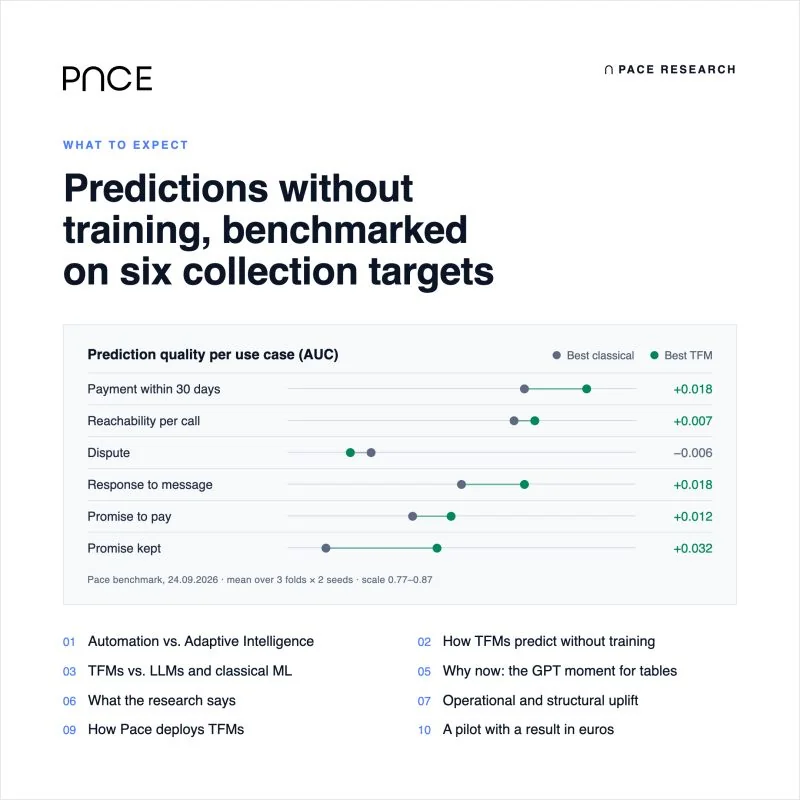
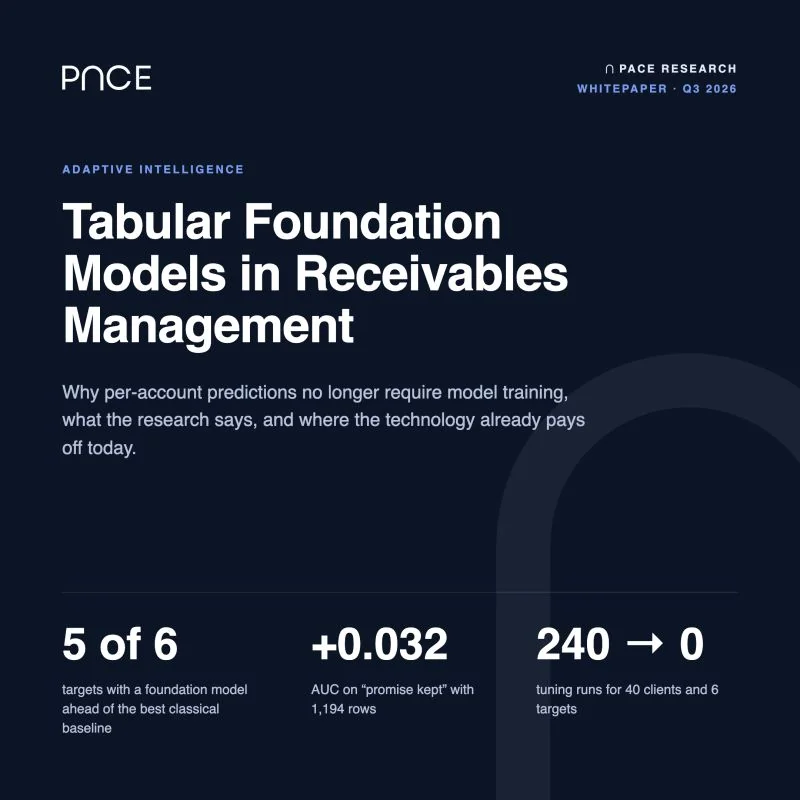
In our benchmark, they matched or beat carefully tuned traditional methods on 5 of 6 tasks, with zero setup per client. The biggest advantage showed up where data is scarce, which is exactly the situation with every new client.
Our new whitepaper explains how it works, what the research says, and where it already pays off today.
Free download:
📄 https://pacepayments.ai/whitepaper-tabular-foundation-models